
The Latifa Practice for Inner Balance
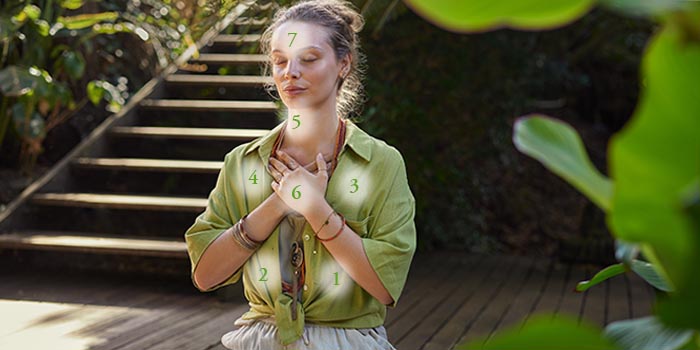
Photograph: Adobe Stock & Chalice Publishing
Practices for restoring and consolidating the balance between the various “centers” or “organs” of the subtle human body are taught in many spiritual traditions, both Eastern and Western. The Latifa Practice described below is drawn from Sufism and was further developed and taught by Reshad Feild for decades in his wisdom school
An excerpt from the book The Inner Work, volume II, by Reshad Feild

 ll our practices are to do with the balancing within ourselves. In any real inner school there is a necessity to continue with practices. It is essential as we go on the spiritual path to keep the balance very carefully. When we get into balance within, then it is possible that we can be open to the higher worlds without being swept away in a gale of wind. The practice I want to introduce at this time can be found in several esoteric traditions. The exact method may vary slightly, but the principle remains the same. Man is a many-dimensional creature, but it is seldom that everything is working in perfect balance. The object of any practice is surely balance and harmony, enabling us to live on many planes of consciousness at once.
I want the Latifa Practice to be seen as sacred in the same way as it was given to me as an extremely sacred practice. It is something that I insist on in the groups in this school, and something that comes from all the traditions, Judaic, Christian, Muslim – that all practices are sacred and that all prayer starts with praise. In the inner tradition, another word for “prayer” is “breath”. If we don’t start our day in praising our Creator and remembering Him, perhaps He will forget us! The attitude in all this is gratefulness. I am grateful I can give you this practice and want you to understand that it comes from a very, very long line of teaching.
An excerpt from the book The Inner Work, volume II, by Reshad Feild
Even if we feel miserable, we can start our practices in this school with praise. Maybe feeling miserable is just the medicine we need to help us get better. If we can’t begin with praise, more than likely we are too serious and thinking only about ourselves and our personal problems. We start with a declaration of unity and with praise. I guarantee that if we do this practice correctly, we cannot not praise our Creator. […]
But what is this practice? It is called the Latifa Practice. In Arabic, latif means “subtle”. The word is difficult because everything is subtle. But we have various centres or gates in our bodies – and I want you to listen with as deep caring as you can!
Any book you read on the centres is inevitably limited. Why? If you talk about the chakras [/], most books say they are up and down the spine. Well, in one sense it is true. In another sense it is rubbish because we are probably fourteen dimensional, certainly six dimensional. Therefore, just to say that they are up and down the spine and to paint such a picture of them is limiting possibility. And we do not want to limit possibility. In some books you will read, there are seven chakras; but in other books, say in certain aspects of Tibetan Buddhism, there are five. And if you read in another one, they state there are twenty-two. Therefore we should not be limited by things, though the sevenfold nature of life is important.
By focusing our attention on certain parts of the body, we can breathe into and through these areas, activating them and bringing them to life.
The keys to this practice are sound, intention, awareness and, of course, breath. Breathe! You need to be able to not lose your attention for the duration of a single breath. This is difficult. It is very easy, actually, but it is difficult because we have so many little I’s running around and so little permanent I. But we do our best. And we mustn’t struggle or fight ourselves too hard if we are having difficulties. Go on, persevere – every day a little bit. We proceed along life’s journey step by step, always doing our best to be awake to the moment, and that is where breathing is so important.
Breathing is a total experience, embracing all aspects of our being. It not only keeps our lungs moving to provide the necessary oxygen for our system, but it also connects us to the worlds outside of us. By focusing our attention on certain parts of the body, we can breathe into and through these areas, activating them and bringing them to life. This is the key we need to work on the locks of the gates, the latifas. We can work a little each day, knowing that although they have been closed for so long, they will open again when the time is right.
The latifas are subtle centres within the subtle anatomy of the Body of God. What is the Body of God? You and me – we are the subtle anatomy of the Body of God, because God made us in His Image. That remembrance alone is a tremendous realisation. These centres or gates, five of which are mentioned in my book Breathing Alive [/], are like ‘reservoirs’. They are endless reservoirs which, by putting attention on them, are activated in love to flow. They remain closed until we knock on them. With sufficient patience and perseverance, they will then be opened from the inside by the invisible gatekeepers. Everything takes time in the relative world, and this is for our own protection. If the gates were suddenly to swing open, we might not be sufficiently grounded to be able to accept the knowledge that we would be given.
The Latifa Practice is a way of distilling substance to produce an extremely refined form of energy in which you know, without any shadow of doubt, that there is no separation.
The movement of the energy through these subtle centres is a form of spiritual alchemy. It is an internal alchemical process from which we can distil substance. “Substance” is a word you will hear me talk about a great deal. It comes from inner work of all sorts, whether it is prayer or yoga or whatever you want to do, whatever it is. The Latifa Practice is a way of distilling substance to produce an extremely refined form of energy in which you know, without any shadow of doubt, that there is no separation. There is no separation.
The object of this practice, if there is an object at all, is to distil energy to reach a point of total understanding and realisation of love. What is love? When people say that God is love, what is God not? We don’t say, “Go for love!”; we go to the source of love. We don’t say, “Go for peace!” (which is also one of God’s Names); we go to the source of peace. Love is the First Cause, and the First Cause is the First Cause of creation, which is the overflowing of the Divine Essence.
So, when at the end of the practice we reach the last latifa, we will have distilled within ourselves energy from its raw state to its highest possibility, which we call “love”. From the actual moment of the big bang – which is not twenty-three billion years ago (that is only a measuring device), but in every conscious breath you take – from that actual moment it is distilled and refined throughout the subtle anatomy of our bodies through these different centres. That is the object of it. I could talk at an enormous length about it because it goes on forever. It is so beautiful!
It is important to remember that although we do focus on certain areas of the physical body, this is only to give us direction. We are actually working with the subtle centres.
Description of the Six Latifas
Although there are obviously many gates that need to be opened, the six that we can activate in this practice are connected to all the others through the subtle bodies. Working with them in the prescribed manner over an extended period of time can, and does, produce profound results. It is important to remember that although we do focus on certain areas of the physical body, this is only to give us direction. We are actually working with the subtle centres indeed.
The First Latifa: Primordial Energy
The first latifa is in the area of the spleen in the left-hand side of the physical body, just around the lower part of the rib-cage. I call it “the centre of primordial energy”. What is the cause of light? What makes light? Fire. That is how we see light. But we must not meditate on fire! If you meditated on fire, you might end up with too much heat. It could also give you a lot of power, but that is not the object. This is the reason that I did not include this centre in my book Breathing Alive. If you want to call it anything, call it “light”; but really it is that which is beyond comparison.
This first gateway provides a type of energy which is vitally necessary for our journey. That is why it is sometimes called vital force (or Chi or Qi [/] in Chinese). If we do not have sufficient circulation of this refined energy, then we are not necessarily able to fulfil our own personal destiny. Our concentration will be relatively poor, and we can easily get diverted from our true aim. Paradoxically, without enough vital force, we do not feel that deep sense of peace that comes with everything moving together towards completion. This energy is not merely basic animal magnetic energy. It is a highly refined energy which is made available to us through inner work. It is refined through breath, sound and visualisation. That is where our practice starts, so find that area.
The Second Latifa: Wish
The second latifa is in the physical area of the liver (that’s under the right rib cage); it is called “wish”. Wish is much more than it sounds. We say in our tradition, “Let Thy wish become my desire.” There is no separation. So when I am desiring to give this, it is God’s Wish. It is not first that I desire and then He wishes, or the other way around. It is instantaneous. What does God wish for the world? What do you wish? You are not going out there to wish for a Rolls Royce; that is not what we’re talking about. We are talking from the top of the highest point of the pyramid, to release and bring forth on to the planet the necessary transformation, because the planet needs it. That is wish.
Let’s contemplate on the word “wish”. It is truly amazing how that one word can help lead us towards our goal. Can we imagine what it was like to really wish upon a star when the world was young and fresh? We all have a primal innocence and enthusiasm with us that we knew as little children, but so often it is covered up by the pain we have suffered and the judgements we have made. Yet the memory is still there and can be brought to life once again.
What is it that we wish for? I don’t mean merely wishful thinking, such as dreaming of an expensive yacht or a beautiful home. What is our true wish? Is it freedom, wonderful boundless freedom? Is it knowledge? What is it? Ultimately, our wish is an entirely personal matter. It is between us and our Creator, requiring only that we are honest.
There is also the question of what we want for our friends and family, what we would wish for the world. The very word “wish” is a gateway to higher worlds, so that impulses of a different order may enter our lives. We need to know what to wish for, and then we should not forget. It takes a lot of polishing to get the keys shiny enough to open the locks!
The Third Latifa: Hope
The third latifa is in the area of the left breast. Can you find that? This is the latifa of hope. I want you to listen very carefully. In the Greek mystery temples, when you entered the temple, above the outer doorway (not the second or the third, but the outer), it said, “Abandon all hope, ye who enter here.” Why? Because hope has led you here; therefore, you don’t need it anymore. I say this because we are distilling and refining the energy with each action, and each breath we take, and with each sound. So we’ve gone from wish to hope.
It is not easy to meditate on this word in a world that is so filled with suffering and pollution. I suspect there are many of us who, at one time or another, have almost given up hope for ourselves or the world. We pass a huddled figure on a freezing winter’s night in New York or London, and we wonder what sort of hope, if any, that person has. And what hope is there in religious and political fanaticism which turns country against country, brother against brother? What hope is there for the millions dying of famine?
Yet there has to be hope. If we lose all hope, then what happens to God’s Hope for us? We can even forget that there is hope in the world, but it is we who have forgotten. There is hope in every heartbeat. Just as there is an inner sound of gratitude, so there is an inner sound lying within the word “hope”. As we activate this centre, we pray we can remember what true hope is and, in doing so, we bring it forth into the present moment. We do sincerely hope for better things for everyone.
What is God’s Hope for the world? What is God’s Hope for you? That comes in the great statement from a hadith of the prophet (Peace and blessings be upon him!) which states, as if God were speaking, “I was a Hidden Treasure and I loved to be known, so I created the world that I might be known.” Love without knowledge, which is the knowledge of oneself, is not enough. Love without knowledge is not enough because how does it become anchored? Love, the First Cause, has to be anchored through the knowledge of oneself.
The Fourth Latifa: Belief
From hope, we move across to the “very secret place” in the right breast, where there is the fourth latifa, another reservoir, which we call “belief”. You could also call it “faith”. Out of this beautiful, beautiful practice, God willing, you will know what trust is without duality. It does not just mean to say, “I trust you” or, “You trust me.” It means knowing trust “with a trust beyond all measure.”
No matter how cynical we are or how much we try to cover up true belief, it is always there in some form or another. These key words are powerful and it is sometimes useful to sit down with a notebook and write whatever arises when we meditate on them. What do we believe in? What would happen if we re-awakened a living belief that has remained dormant for so long? Is it possible, through true belief, to come to such a state of conviction that we could leave this world with a credo that goes far beyond merely the concepts of the relative world, so that our children and our children’s children may come to understand? It is a great challenge, but a wonderful one!
Without inner belief there can be no conviction in our own essential reality as part of the whole. We fall into disappointment. Belief is not a complicated matter; it is believing in the ultimate goodness of all life. When we have conviction in this, knowing ourselves to be custodians of the planet, we will take the necessary steps to put ourselves in the stream of service. Love is pure energy, and love is not to be wasted.
By the time you have belief and faith intertwined in love, here in presence and knowledge, then you have sufficient of the refined strength which you need. And we need to do it everyday. We are all human; nobody is perfect. We need to be able to say, “I surrender, I obey” to, you might say, the higher worlds, but not to any half-measures. There are no intermediaries in our tradition. Even Mary turned straight to her Lord, Jesus turned straight, all the prophets from Abraham onwards have all turned straight. No intermediaries! No intermediaries! We don’t turn around and surrender to and obey concepts or archetypes of our own creation, or to our forebears or our ancestors. No way – go straight!
The Fifth Latifa: Surrender
The fifth latifa is situated at the level of the throat centre. Here we say, “I surrender, I obey.” The throat centre can be seen as having numerous “jobs to do”. All our food and water is taken into the mouth and then passes down through the physical throat, as does the air we breathe. Our voice also comes from the throat. “In the beginning was the Word.” It is said that the first word was kun, “Be!”, and then all became. The Divine Command from the Heart of God was carried on the first manifested sound in the universe, the sound of the Hu. It is here, in this area, that we meditate on the idea of pure surrender or abandonment. As we bring the vital force through our hands to activate the throat centre, we open this gate so that the higher worlds can work through us. There is a prayer by Charles de Foucauld [/] which I personally find very helpful to repeat at this time:
The Prayer of Abandonment
Father, into Thy Hands I abandon myself.
Do with me whatever You will,
and whatever You do,
I will thank You
and remain always grateful.
Let only Thy Will be done in me
as in all Your Creatures.
Into Thy Hands I commit my spirit.
I give it to You
with all the love in my heart,
For I love You, Lord,
And so long to give myself
with a trust beyond all measure.
“God needs man” – and now we are prepared to surrender ourselves for His Work on earth. Let heaven come on earth, and may the earth turn into heaven! Perhaps here we can begin to hear the message that is carried to us, giving us the knowledge that is necessary to anchor love, the knowledge of ourselves.
If we have managed, God willing, to distil the energy sufficiently, by that time we have that refined strength which is no more raw strength. It is not like the going-out-and-hitting-the-baseball type of strength. It is a very refined, pure strength – “pure and adaptable like water”, which is the meaning of the word suf in Arabic. If we say these words in love and mean what we say, totally accepting authority, “I surrender, I obey,” it is the most joyous thing we could imagine. It really is.
The Sixth Latifa: Love
Finally we come to the sixth latifa, the centre of the chest, and say, “I love.” Now what does this mean? The “I” that is saying “love” is love. It is the overflowing of the Divine Essence. As Gurdjieff [/] said, “Life is real only when I am.” It is not “I love”, as though there are two things. It is one thing. I am the expression of God’s Love. I am the manifested Consciousness of God. I am a witness to the unity. I am a witness to the Unity of God.
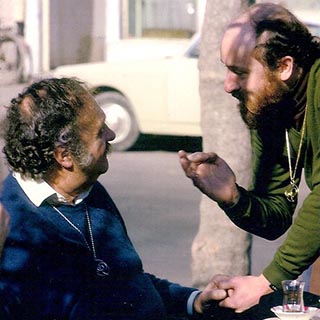
Bülent Rauf and Reshad Feild in Turkey in 1971. During some time, the members of their school used to wear a nacklace with the emblem of a calligraphy of the word Hu
Our Hands and the Sacred Sound Hu
Between each of these latifas there are what we might call “canals”. They are already open. You are not opening them as though with a knife. It is just that they have never been used. You are opening up possibilities through them. It is like in my first book, The Last Barrier, when I talked about water flowing down a dried up river bed.
You will be moving your hand, first of all, from the area of the spleen on the left side across to the area of the liver on the right side (that is slightly up from the first one), then across up to the left breast and then across the chest to the right breast, which is very often forgotten. From there, you open up the channel to the latifa in the area of the throat. And then you move down to the centre of the chest, which is the last latifa, we use in this stage of the practice.
During the practice, you must never lose your attention because what you are doing is carrying the energy and refining it, from one centre to the other, by putting attention, which is also like sensing, into the hands. What are you doing? The hands are the extension of the heart centre, and there are five levels of magnetism in the heart centre. You are actually increasing the flow. If you were to put your finger in a little puddle of water and draw it along the floor, you would draw the water with it, wouldn’t you? It’s the same principle. Each time we are refining the energy. As in alchemy, or any kind of distillation, you only need a little of something to activate the next.
As we do the practice, we will be sounding three times the Hu in each of the latifas, except for the last one, where we sound seven. Always during the last Hu, we move our hands to the next latifa. May I try and transmit from essence what the meaning of Hu is? The sound of it cannot be expressed in words. That is the first thing, but a few keys can be given. You won’t read this in books. At least if you do, by the time you have understood, it is too distant. If we are in love together, now, there is no separation and no distance. And if you don’t understand it now, my prayer for you is that one day when the time is right you will. People in the Sufi tradition say, “La illaha il’ Allah – Hu.” The Hu is the first manifested sound in the universe. Don’t relate it to Om or Aum; it is a different system, completely different.
The sound Hu is also a sacred, sacred, sacred sound and should never be underestimated. You hear it in the wind in the trees, you hear it in the electrical system – you hear it everywhere. It carries all the unmanifested worlds with it, everything. It carries all the Holy Names of God. It carries all the world of possibility. It carries everything from the invisible angelic kingdoms, absolutely everything, into our world. And you can hear it everywhere. You cannot say what it means in language because language will, in a sense, always produce something opposite. But let us just say it is Hu that allows people to say “Allah”, and not the other way around.
Three is the first number that can manifest anything, and therefore we sound the Hu three times into each of the latifas, except for the last, where we sound seven. Seven is the esoteric number of the Virgin Mary. It also means the matrix, blueprint, the law of octaves and many other things.
During the practice, you must never lose your attention because what you are doing is carrying the energy and refining it, from one centre to the other, by putting attention into the hands.
Step-by-Step Method
Before you proceed with this practice, make a promise in essence that you will do this work without any expectation, and with no greed or ambition. This cannot be stressed strongly enough. No results will come from wrong attitude. It is only necessary to do the practice in love and for love. Attitude is very important, and throughout this practice the correct attitude is one of gratitude. There is a certain inner sound that comes with this word. It is almost a sense of reverence and awe that we can even be allowed to be here and to be given some of the keys to unlock the gates.
First of all, you settle yourself carefully with your back straight in a chair, or you sit on the floor, prepared to participate in a sacred practice given to us by God, to participate as consciously as possible in something that I was given, and which has been handed down through initiatic schools for thousands of years. Praise God in some way; read a poem, look at a beautiful flower and say, “Thank God”, say thank you somehow. Listen to some music, do some breathing. You can say a prayer from whatever tradition, but praise God first. Wouldn’t you want to be acknowledged? Remember the “Triple-R Ranch” I wrote about in former papers; the first R is recognition, the second R is redemption, and the third R is resurrection. You want to be recognized, don’t you? Isn’t that what you are all crying out for? Yes. What is a child? We want to be recognized in essence. As we are doing this practice, we praise our Creator, Who wants to be recognized for creating us. Right? We are on the “no-blame train”. Starting off with praise makes all the difference to just sitting there and doing the practice in order to benefit ourselves. We are participating in a cosmic event, because this is the subtle anatomy of the Body of God. If you know the Present Moment Practice [see The Inner Work, volume I, page 350], start with that. Remember there is no God but God, and we need to be really here for this practice.
Begin the practice by establishing the rhythm of the Mother’s Breath. The rhythm is important. Breathe in to the count of seven, pause for one count, breathe out to the count of seven, pause for one count. The length of the breath and the speed of the rhythm are very personal and should be what feels comfortable for each individual. Watch the breath moving in and out and contemplate on the miracle of breathing. Just as life itself pervades every part of the universe, be aware of the breath interpenetrating every fibre of your being. You can stand up and walk in the open air, still remaining aware of the breathing. The practice can even be done standing up with your back pressed against the trunk of a favourite tree, but it is obviously essential not to let the mind wander. You will need all the energy of concentration you have. The eyes can be open or closed throughout the practice. On the in-breath, breathe into the solar plexus. At the same time, through visualisation, you can consciously breathe in the energy from the earth and from all around you. Then, on the out-breath, imagine that you are breathing out from the centre of the chest, down through your arms and out through your hands. It is a beautiful sensation when this is done correctly, and of course the implications, even in human relationships, are very great indeed.
Remain as conscious as you can throughout this practice. You can take a long time with it, if you want. You can dwell on one of the latifas for quite a while and contemplate, for example, on the beauty of hope, or the beauty of wish, but we only sound the Hu three times into each latifa. That is important.
When you are ready, place your hands over the area of the spleen, around the left side of the rib cage, at about the height of the last three to four ribs. If you are right-handed, place your right hand onto the body first (with the palm facing your body), which is then covered by the left hand. If you are left-handed, it would be the other way around. Breathe into the solar plexus as in the Mother’s Breath and then breathe out, through your hands, into the area of the spleen. Visualise pure light-energy flowing through your hands and being received by that centre. Try and be conscious of every movement and choice. If you didn’t make a conscious choice picking your hands up, put them down again and start anew. We can forget very easily. Decide that you are going to do it, and then do it. Having got there, gratefully, let us contemplate on and recognize the primordial energy of the creative principle. Don’t have visions of power, of fire or something. When you are ready, and you are present, and you feel the Presence of God in the moment, in the room, sound the Hu three times into the area of the spleen. On the third one, as you are sounding the Hu, bring your hand across to the second major latifa of wish, as it were opening up this canal, bringing the energy across and putting it into that reservoir. Don’t lose attention with the breath and the Hu as you move your hands across.
Hu, Hu, Hu
So, when you go from the frst latifa to the second one, you are taking the primordial energy, the raw, unadulterated energy of creation itself (and you only need a tiny bit of it), across to activate the reservoir of the second major latifa which is called wish. Now you can just rest and breathe consciously. You don’t have to rush this. Contemplate on wish. You could say, “Let Thy Wish become my desire.” What does “wish” mean – not wishful thinking, not expectation, but God’s Wish for us? And you have, as it were, taken the lid off this endless reservoir of God’s Wish for us, and you have brought this energy from the first area to activate it. It is like making yogurt. You need that which activates the yogurt, and then you take a little bit of that yogurt to activate more milk and make more yogurt. Inside yourself say, “I wish” or just “Wish” and sound the Hu three times. On the third Hu, you will move your hands to the left breast area.
Hu, Hu, Hu
Consciously bring the energy to the left breast, the latifa of hope. Open up the canal and bring this more refined energy to this centre. Listen to the sound of your own heart. Contemplate on the meaning of hope. Put all of your attention on hope, God’s Hope for us, for the world, our prayer, our hope for the world, for our children and children’s children, the unmanifested Aspect of God, the world coming in, the unmanifested aspect, hope. The whole world is in these reservoirs, worlds and worlds, layers and layers. And now that we have brought the energy to this reservoir, we sound the Hu again three times.
Hu, Hu, Hu
Bring the energy across the chest, through that canal, to the “very secret place” in the right breast area. This is the latifa of belief, of faith. “I believe,” not in duality. It brings gnosis, this one. Some traditions meditate entirely on that centre. I remember Sri Ramana Maharshi [/], the great Indian saint and mystic. His devotees were very conscious that they remember this place, the very secret place. Now we should have a good balance between both the breasts and all the areas of the subtle anatomy of the Body of God. There is only He, beyond all concept of “you” and “me”, “he” and “she” – beyond the beyond. Again the three times the Hu.
Hu, Hu, Hu
Consciously bring your hands up to the throat centre. Remember the First Cause, which is love. When we say, “I surrender, I obey,” we are surrendering to and obeying the higher laws. There is only One Will. We know that what is wanted of us is harmony, is beauty and joy – not misery! – ease and, as we say in our tradition, “victory”, that is the victory over the inner turmoil, so that all that remains is God, the Beauty of God. There is only One God. So we surrender, and we really mean it in our hearts and our inner being. We say it inside as we sound the Hu, “I surrender, I obey.” It is so beautiful and so joyful. We know it is safe; we know it is all right. And we sound the three Hu again.
Hu, Hu, Hu
Consciously we move our hands straight down the middle of our body, coming to the centre of the chest, opening up that channel of refined energy. We can imagine a perfect red rose opening to the light under our hands. The contemplation is on the word love. We contemplate on God’s Love for us so that, in knowing we are loved, we can go out into the world, acting as messengers of His Love. “Love the Lord thy God, and love thy neighbour as thyself.” The cycle is complete. There is no separation. Here, we will sound the Hu seven times. Inside, we are saying, “Love. I love.” Life is real now because “I am” is the expression of God’s Love. This “I” brings forth and unfolds the Love of God. There is separation no longer.
Hu, Hu, Hu, Hu, Hu, Hu, Hu
On the last Hu, in absolute consciousness and attention, without forcing effort but with “right effort” (as Buddha would say), put all your attention into the third eye centre between the eyebrows, and then bring your forehead on to the floor in humility. Not only does it ground all the energy, but it is said that if you are conscious, in love, gentle and in beauty at that moment, every atom in the universe is there as your head touches the floor on this last sound. You can visualize this step if it is not possible for you to kneel on the ground. We are in complete oneness and unity with the earth, with the planet, with God, with each other, and yet absolutely unique – the unique within the unity, within the One. And that completes the practice. It starts with gratefulness and it ends in gratefulness.
There is one more task. Come into a sitting position once again, being absolutely still and grateful that you have been allowed to participate in this beautiful event, this beautiful practice. When you open your eyes, remember these words: “These are the eyes through which God sees.” Look through your eyes and not from them. “These are the ears through which God hears.” We have become the witnesses to the unity. Always open your eyes consciously and look through them, because these are the eyes through which God sees. There are no other. And then you can see in a different light. […]
You are eternally what you really are. And when you die – preferably before you die – what you take with you is the knowledge of the Unity of God. Anything else is too little. From this practice, I pray that you will come to know the Light behind the sun, which gives light to the sun of our own universe.

© The Literary Estate of Reshad Feild 2026